
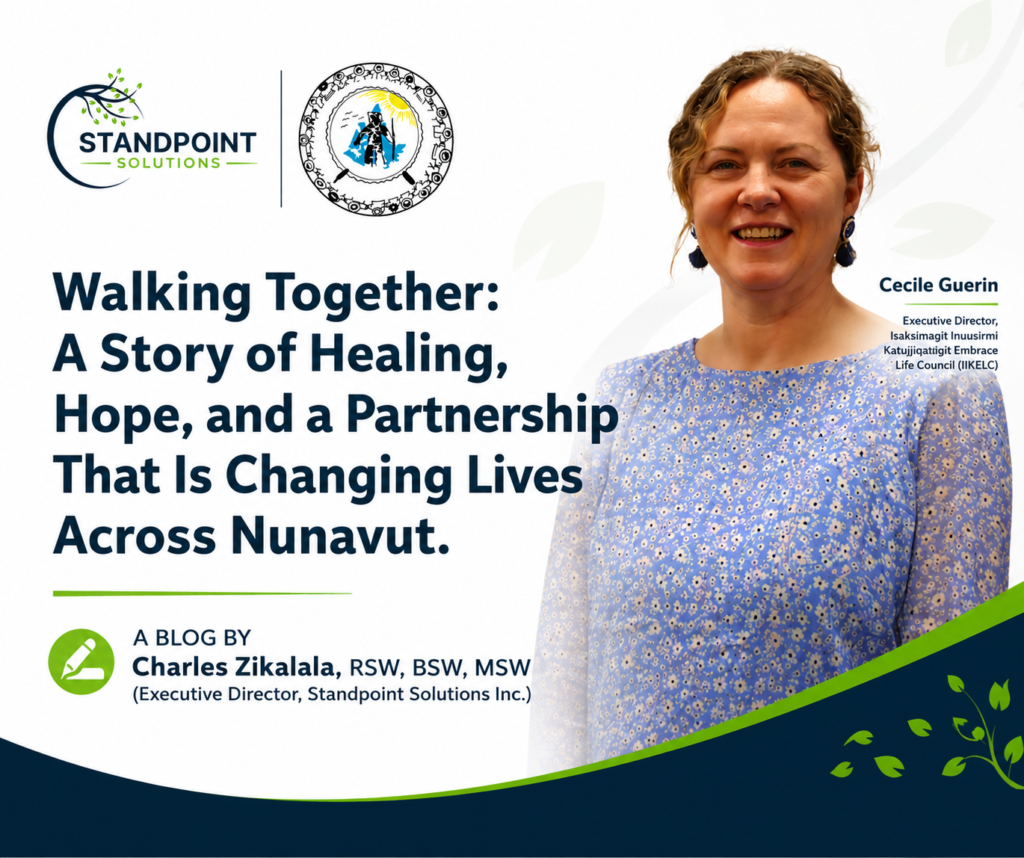
Some projects change the way you see your work. For me, partnering with the Isaksimagit Inuusirmi Katujjiqatigiit Embrace Life Council (IIKELC) to develop four online courses for Nunavut has been one of those projects. I want to share the story of this work with you, because I believe it speaks to something bigger than any one organization or any one course. It speaks to what becomes possible when two teams come together with trust, respect, and a shared commitment to walking alongside the people they serve.
A Council With a Mission, and the Courage to Carry It
Since 2004, the Isaksimagit Inuusirmi Katujjiqatigiit Embrace Life Council has stood as one of Nunavut’s most respected voices in life promotion, healing, and suicide prevention. As a not-for-profit working alongside partners in the Nunavut Suicide Prevention Strategy, including the RCMP, Nunavut Tunngavik Inc. (NTI), and the Government of Nunavut, the Council has spent more than two decades doing some of the hardest and most necessary work imaginable. They walk with families through grief. They sit with communities in mourning. They build bridges between Inuit knowledge and modern mental health practice. And they keep showing up, year after year, with steadiness and heart.
At the center of this latest chapter is Cecile Guerin and her team. Anyone who has had the privilege of working with Cecile knows the kind of leader she is. She is thoughtful, deeply rooted in community, and unwilling to settle for surface-level solutions when the people of Nunavut deserve more. From our very first conversation, I could see that Cecile was leading with both vision and integrity. She wanted these courses to be useful, honest, and culturally grounded. She wanted them to belong to the Council and to the people of Nunavut, not to anyone else. That clarity shaped everything we built together.
Under her leadership, IIKELC set out to do something ambitious. They wanted to take the wisdom that already lived inside the Council’s programs and make it accessible to anyone in the territory who was ready to step up and help. That vision became the seed for four powerful online courses.
The Four Courses We Built Together
Each course was designed with a specific audience in mind, and each one carries the same DNA: cultural grounding, practical skill-building, and deep respect for the people who will use it.
Healing Support Group Facilitator Training is a 22-module course that prepares community members in Nunavut to lead Healing Support Groups for grieving people. It does not require clinical credentials. What it asks for is presence, willingness, and a commitment to walking alongside others through grief. This course is, in many ways, the heart of the project. It honours Inuit knowledge and cultural practices, treating them not as decoration but as the foundation of healing itself. When I think about the facilitators who will take this course and the people they will support, I feel deeply honoured to have played a part in shaping it.
Reach Out (Suicide Awareness) Workshop comes in two versions, one for adults and one for youth ages 15 to 24. Built around the simple but powerful framework of Recognize, Ask, Listen, and Refer, Reach Out gives ordinary people the language and confidence to notice when someone is struggling, ask the hard question directly, listen without judgment, and connect that person to support. The youth version was designed specifically so that young people can show up for one another with care and skill.
Talking About Suicide in the Workplace is a 12-module training built for employers and workplace leaders across Nunavut. It weaves together legal and ethical guidance, Inuit Qaujimajatuqangit principles, the Ask, Care, Escort (ACE) model, crisis protocols, lateral violence prevention, and trauma-informed leadership. It is the kind of training that turns workplaces into places where people actually feel they belong.
Talking to Children About Suicide is a 12-module postvention program for parents, grandparents, teachers, Elders, and caregivers. When a suicide touches a community, children need adults who know what to say and how to say it. This course gives those adults the tools, the words, and the confidence to be that steady presence.
Together, these four courses cover the full circle of life promotion and healing. Preventing harm before it happens. Responding when someone is in crisis. Supporting workplaces and families. And helping communities heal long after the hardest days have passed.
How I Approached This Work
When I began leading the development of these courses, I made a decision early on. I would listen first and write second. I immersed myself in the work of the Council. I learned from Cecile and her team. I read, I asked questions, and I made sure every module reflected the realities of life in Nunavut rather than a generic template imported from somewhere else.
I also made sure that every choice along the way honoured the seriousness of the subject and the strength of the people who would be taking the training. The grounding exercises at the start of each session. The reminders about crisis resources. The use of phrases like “died by suicide” instead of older language that carries shame. The structured activities that give learners room to practice, reflect, and grow. None of this happens by accident. It happens because someone takes the time to do it right, and because the partner you are working with insists on nothing less.
Why This Partnership Works
Strong partnerships are built on trust, and trust is built on competence. At Standpoint Solutions Inc., we came to this work with a clear philosophy. The organization holding the knowledge should always remain in the driver’s seat. The Isaksimagit Inuusirmi Katujjiqatigiit Embrace Life Council owns the courses, the materials, and the intellectual property. Our role was to serve that vision, not to replace it.
That approach matters. Across the North, communities have seen too many outside consultants arrive with pre-packaged solutions and leave behind very little of lasting value. We wanted to do the opposite. We wanted to center Inuit knowledge, protect cultural practices from being taken out of context, and build tools that the Council can carry forward on its own terms for years to come.
For us at Standpoint, this is what credible work looks like. Not flashy. Not rushed. Just careful, respectful, and rigorous from start to finish.
A Model Worth Following
There is something quietly remarkable about what Cecile Guerin and her team have built. They have taken topics that many organizations find too heavy to even discuss, healing and suicide prevention, and turned them into accessible, structured, culturally grounded learning that anyone in Nunavut can take. They have created resources that workplaces, schools, families, and frontline workers can all use. And they have done it in a way that other organizations across Canada and beyond would be wise to study.
For funders, this is what high-impact investment looks like. For local organizations in Nunavut and across the North, IIKELC is now positioned as a natural mentor and partner for anyone who wants to build healing and life promotion work that truly fits the community it serves. For the public, these courses are an open invitation to learn skills that could one day help a friend, a coworker, a family member, or a child through their darkest moment.
If your organization is looking for guidance on how to develop training that honours both lived experience and cultural knowledge, I would encourage you to reach out to the Isaksimagit Inuusirmi Katujjiqatigiit Embrace Life Council. The door is open, and the lessons learned through this project are exactly the kind of lessons that grow stronger when shared.
Looking Ahead
I am proud of this work. I am proud of the team at Standpoint Solutions Inc. who supported it, and I am even prouder of Cecile, her team, and the Council itself for trusting the process and pouring so much of themselves into making these courses real.
The work of healing and life promotion is never finished. But thanks to the leadership of IIKELC and the partnership that brought these four courses to life, more people across Nunavut now have what they need to step forward, speak up, and walk alongside one another through both the hardest and the most hopeful moments of life.
That is something worth celebrating. And I believe it is only the beginning.
To learn more about the Isaksimagit Inuusirmi Katujjiqatigiit Embrace Life Council and its programs, or to explore how Standpoint Solutions Inc. can support your organization in developing meaningful, culturally grounded training, visit our websites or connect with us on our various Facebook Pages. We would love to hear from you.